
Twenty Rose Vibrators Is Not an Assortment
Many adult retailers grow their catalog one hit product at a time and end up with ten near-identical SKUs and no accessories. A practical way to build a multi-brand range that covers the category, climbs price tiers on purpose, and keeps customers reordering.
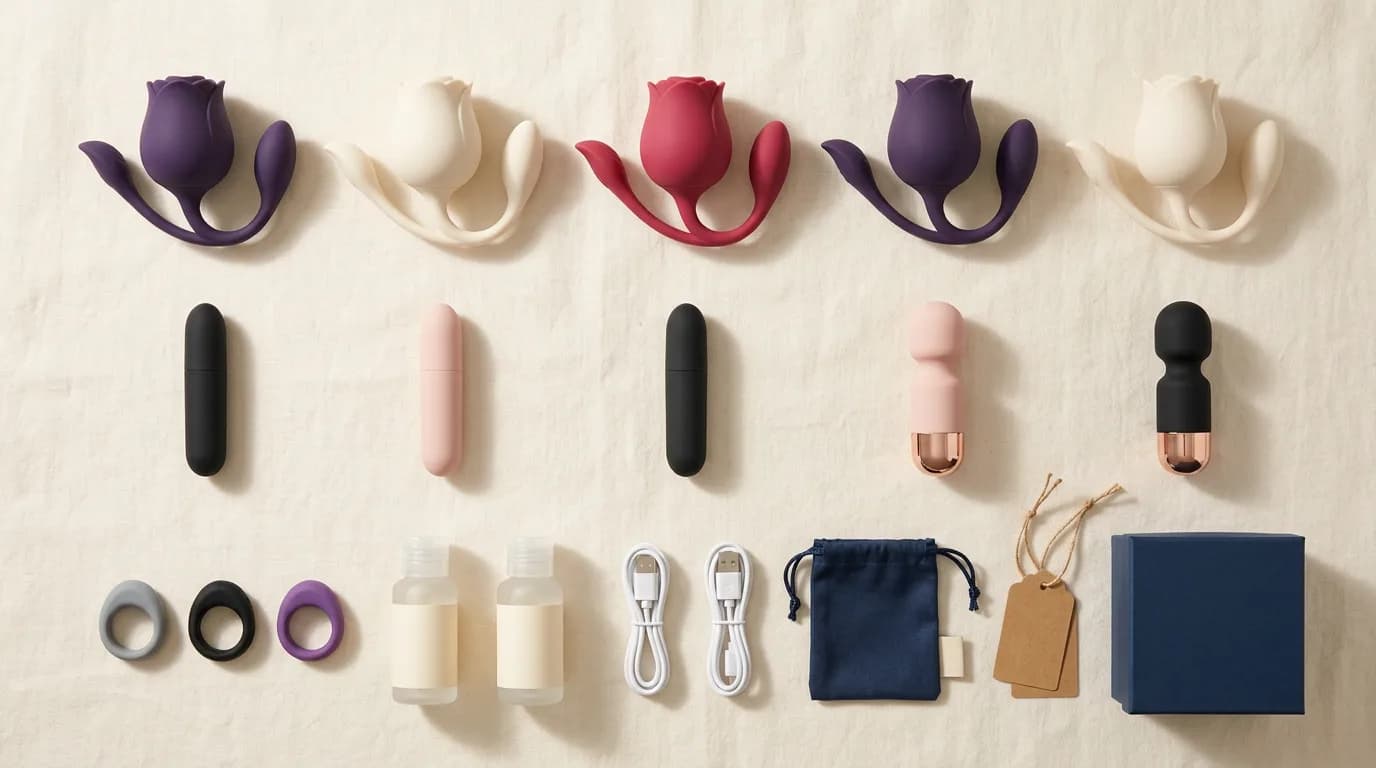
Open the catalog of almost any adult retailer that has grown organically and the pattern is familiar: a dozen rose-shaped suction stimulators from four different brands, a handful of pink bullets, and nothing for couples, nothing for men, and no lubricant or cleaner to go with any of it. Each product was a reasonable buy on its own. Together they are a pile, not a range.
A multi-brand assortment should add coverage, not duplicates. The brands you carry matter less than the job each SKU does on your shelf or product page. Here is how the buyers who get this right usually structure it.
Start with the category map, not the brand list
Before adding a second or third brand, sort every SKU you already carry into the product groups customers actually shop by. For adult wellness products these usually look like this:
Internal vibrators: bullets, rabbit-style, G-spot and curved shapes
External and clitoral stimulation: suction stimulators (including rose forms), mini wands, finger and palm vibes
Male products: masturbators, sleeves, vibrating rings, pumps
Couples: remote and wearable vibes, app-controlled toys, enhancement rings
Wellness: kegel trainers, massagers, warming and gentle-pressure formats
Accessories and consumables: lubricants, toy cleaners, charging cords, storage pouches
Count the SKUs in each group. A group with one or zero SKUs is a gap. A group with six or more near-identical items is an overlap. New brands should be chosen to fill gaps, not to add a seventh item to a group that is already crowded.
Give every SKU a job
A healthy range is balanced across four roles. When a SKU has no clear role, it usually ends up as dead stock.
1. Hero items: they bring people in
Trend-led forms such as the rose-shaped suction stimulator or a compact mini wand. They drive search, social attention, and first-time purchases. Margin is often thinner, competition is highest, and they must never be out of stock. Pick two or three, not ten.
2. Core earners: they pay the bills
Dependable mid-tier products with solid specs and no gimmicks: reliable bullets, easy-to-use wands, simple rings. They sell steadily all year and generate the repeat orders that make forecasting easier.
3. Premium items: they lift the basket
Products with a visible reason to cost more: app control, stronger motors, larger batteries, premium silicone, better packaging. These give customers a step up and protect your margin. You need fewer of them, but each one should have a clear spec story.
4. Replenishment items: they bring people back
Lubricants, toy cleaners, spare charging cords, and storage pouches. They are low-risk, easy to ship, and the natural add-on to every device sold. Buyers who skip this group leave the most reliable repeat revenue on the table.
Build price tiers on purpose
The most common multi-brand mistake is letting every brand cluster in the same price band. Instead, plan a ladder where each step up has a reason the customer can see or feel.
Entry: impulse and gift purchases, simple one-or-two-mode devices, lower battery capacity, standard packaging
Core: the volume tier, with better silicone, more modes, and a motor and battery that hold up in daily use
Premium: app or remote control, stronger build, gift-ready packaging, and complete test documentation
What justifies each step? Battery capacity, motor endurance, silicone grade, wiring protection, and how the soft parts are bonded to the housing. Our teardown article, There Is Always More Than Meets the Eye, shows how to compare those hidden parts before you set a tier.
Keep brands from competing with each other
Two brands can both be good and still be wrong together if they sell the same product to the same customer at the same price. Three habits help:
Assign each brand a role: one for value and repeat purchase, one for design-led gifting, one for performance and features
Do not carry the same form in the same tier from two brands unless the spec difference is clear, such as waterproof rating, runtime, or control type
Hold every brand to the same material and documentation standard, so your shelf makes one consistent promise about safety and quality
Plan for your channel and your market
The same range does not work everywhere. A discreet online store, a boutique shop, and a wellness retailer will all stock different packaging and different depth.
Online: discreet outer packaging, clean product photography, and enough accessories to support add-to-cart
Boutique and in-store: display-ready packaging, tester-friendly formats, and clear price-point grouping
Wellness-focused retailers: softer forms, kegel and massage products, and complete material documentation upfront
Target markets: confirm the certifications and test reports required for each destination (for example CE, RoHS, and REACH for the EU, and FCC for rechargeable devices in the US) before you commit to an order
Want help mapping your range?
Tell us your channel, target markets, and price range. We can suggest a mixed-brand starter order that fills the gaps in your category map, with MOQs and documentation lined up from the start.
Related questions
What is the minimum order quantity for a first purchase?
Contact us for MOQ and pricing. Use the quotation form on the For Buyers page.
Ready to move forward?
Request the full trade catalog or speak with a sales representative about your assortment.
More on Procurement & OEM